LMI protects the bank, not you — and it can cost $20,000-$40,000 on a Sydney home. Here's how the bands work, and the four legitimate ways to skip it.
Lenders Mortgage Insurance (LMI) is one of the most expensive and least understood costs in the home buying process. It is a one-off premium added to your loan when you borrow more than 80% of the property's value. It protects the bank, not you. And on a Sydney or Melbourne home with a 5-10% deposit, it can cost $20,000 to $50,000 — money you'd much rather keep in your pocket.
What LMI actually is
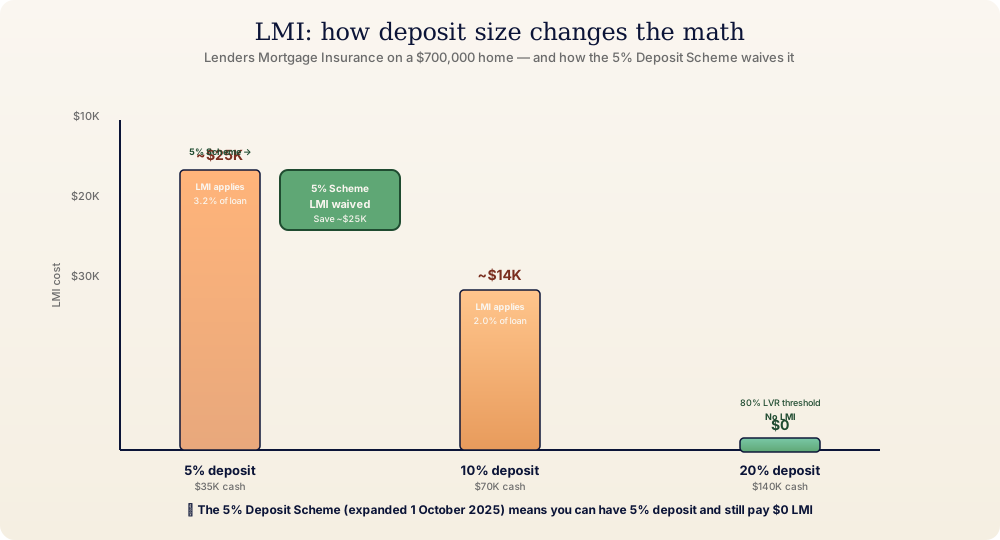
When you borrow more than 80% of a property's value, the bank considers the loan riskier. To protect itself against the chance you default, the bank takes out an insurance policy. The premium for that policy is added to your loan balance.
Critical point: the insurance is on the bank's loan, not on your ownership of the property. If you default, the insurance pays the bank (not you), and the bank can still pursue you for any shortfall.
Source: ASIC MoneySmart — moneysmart.gov.au
How the bands work
LMI premiums are calculated as a percentage of the loan amount, depending on your loan-to-value ratio (LVR) and the size of the loan. The exact percentages vary by lender and insurer (Genworth, QBE, Helia), but the broad bands in 2025-26 are:
| Your LVR | Approximate LMI premium (as % of loan) | Example: $700,000 home with 5% deposit |
|---|---|---|
| 60% or less | 0% (no LMI) | — |
| 60-70% | ~0.35% | — |
| 70-80% | ~0.7% | — |
| 80-85% | ~1.2% | — |
| 85-90% | ~2.0% | ~$13,300 |
| 90-95% | ~3.0% | ~$19,950 |
| 95%+ | ~4-5% | ~$26,600 - $33,250 |
These are industry averages; your lender's quote may be slightly higher or lower. The LMI premium is added to your loan balance and accrues interest over the life of the loan.
The four legitimate ways to avoid LMI
1. Use the 5% Deposit Scheme
From 1 October 2025, eligible first home buyers can use the 5% Deposit Scheme to buy with a 5% deposit and skip LMI entirely. The Government guarantees the next 15% of value to the lender, which removes the need for private mortgage insurance.
No income cap, no place limit. Most major banks and several non-banks are panel lenders. The savings on a $700,000 home with 5% deposit are typically $20,000-$33,000.
2. Use the Family Home Guarantee
If you're a single parent or guardian with at least one dependent child, the FHG lets you buy with a 2% deposit and skip LMI. The Government guarantees the next 18% of value.
No income cap. The savings on a $600,000 home with 2% deposit are typically $25,000-$35,000.
3. Use a state lender (Keystart or HomeStart)
WA's Keystart and SA's HomeStart are government-backed lenders that don't charge LMI on their low-deposit loans. Keystart accepts 2% deposit; HomeStart accepts 2-3% deposit for new builds. The trade-off is that you're locked into the state lender's product range and rates.
4. Save a 20% deposit
The traditional way. At 80% LVR or below, no LMI is required. The catch is the time it takes to save — often 5-10 years for first home buyers in capital cities. Using the First Home Super Saver Scheme can cut this time significantly.
What about a 10-15% deposit?
Most lenders charge some LMI at 85%+ LVR but with discounts for borrowers with stronger deposits. A 15% deposit on a $700,000 home (i.e. $105,000 deposit, $595,000 loan, 85% LVR) might attract ~1.2% LMI = ~$7,140. Still worth avoiding, but far less painful than a 5% deposit scenario.
Can you add LMI to your loan and pay it off slowly?
Yes — LMI is normally added to your loan balance. The total loan becomes $700,000 + $25,000 (LMI) = $725,000. You pay interest on the whole amount over 30 years. At 6% interest, the extra $25,000 in LMI costs you about $150,000 in interest over the life of the loan. This is why avoiding LMI is one of the single best financial decisions a first home buyer can make.
Are there any other hidden costs?
LMI is usually the largest "hidden" cost in a low-deposit purchase. Other items to budget for:
- Stamp duty — varies by state; first home buyer concessions usually apply
- Legal and conveyancing fees — $1,500-$3,000
- Building and pest inspections — $500-$1,000
- Loan establishment fees — $0-$1,500 (most lenders waive for first home buyers)
- Mortgage registration fees — $150-$300
- Title insurance — $200-$500
- Moving costs — $500-$2,000
Most financial advisers recommend budgeting 5% of the property price for "everything except the deposit."
LMI is the single biggest avoidable cost in a low-deposit home purchase. The four options above are all legitimate, all government-supported, and all designed to put you in a home faster without paying tens of thousands in insurance.