Beyond the deposit and the mortgage: every cost first home buyers forget about. Budget an extra 3–5% of the property price for the things nobody warns you about.
The deposit is the headline number. The mortgage is the obvious cost. But between exchange and the second year of ownership, you'll spend another 3–5% of the property price on costs most first home buyers don't see coming. This article walks through them all — with realistic dollar ranges for 2026.
The full cost stack (2026)
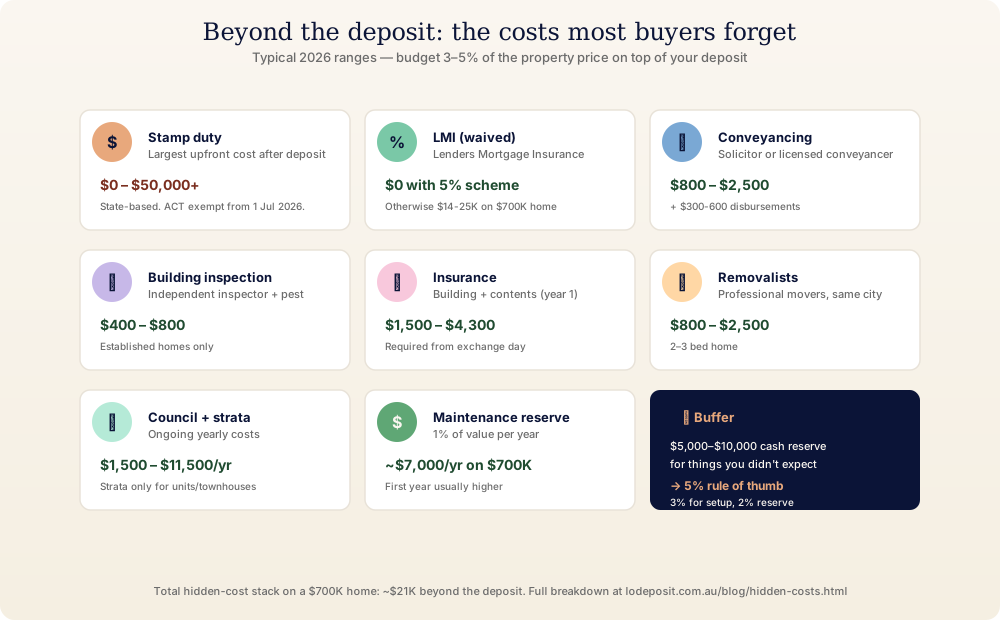
| Cost | Typical range (2026) | Who pays |
|---|---|---|
| Stamp duty (transfer duty) | $0 – $50,000+ | Buyer (some states exempt FHB) |
| Lenders Mortgage Insurance (LMI) | $0 – $40,000 | Buyer (waived under 5% scheme, FHSS, Keystart, HomeStart) |
| Conveyancing / legal fees | $800 – $2,500 + disbursements | Buyer |
| Building & pest inspection | $400 – $800 | Buyer |
| Loan establishment fee | $0 – $1,500 | Buyer |
| Mortgage registration fee | $150 – $300 | Buyer |
| Title transfer / PEXA fee | $100 – $300 | Buyer |
| Removalists | $800 – $2,500 (same city) | Buyer |
| Building insurance (first year) | $1,200 – $3,500 | Buyer (required from exchange) |
| Contents insurance (first year) | $300 – $800 | Buyer (optional but recommended) |
| Council rates (annual) | $1,200 – $3,500 | Buyer |
| Strata / body corporate (annual, units only) | $2,000 – $8,000+ | Buyer |
| Connection fees (water, electricity, gas, internet) | $100 – $500 | Buyer |
| Maintenance & repairs reserve | 1% of property value per year | Buyer (recommended) |
For a $700,000 established home in Sydney, the realistic pre-settlement cost stack looks like:
- 5% deposit: $35,000
- Stamp duty: $0 (NSW FHB exemption under $800K)
- LMI: $0 (under the 5% Deposit Scheme)
- Conveyancing + disbursements: $1,500
- Building & pest inspection: $600
- Loan establishment + mortgage registration: $700
- Removalists: $1,500
- Insurance (12 months building + contents): $2,000
- Council + water rates adjustment: $1,500
- Buffer for surprises: $3,000
That's a total upfront cash need of about $46,000 — not the $35,000 deposit that the listing suggested. Many first home buyers need to bring 7–10% of the property price to settlement, not the headline 5%.
1. Stamp duty (transfer duty)
Stamp duty is the single largest upfront cost after your deposit. It's a state-based tax, calculated on the property price (or market value, whichever is higher). For a first home buyer, every state and territory offers some form of exemption or concession — but the shape and thresholds vary dramatically. The ACT abolished it for all first home buyers at any price from 1 July 2026. QLD and SA charge $0 on new homes at any price. NSW gives full exemption under $800K. VIC under $600K. Tasmania's established-home exemption expired on 30 June 2026 and was not extended.
See our complete state-by-state grants & concessions table for current figures.
2. Lenders Mortgage Insurance (LMI)
LMI is a one-off premium added to your loan when your deposit is less than 20% of the property value. It protects the bank, not you — and it can cost $15,000–$40,000 on a Sydney home with a 5–10% deposit. The good news: the federal 5% Deposit Scheme (expanded on 1 October 2025), the Family Home Guarantee, Help to Buy, Keystart (WA), and HomeStart (SA) all waive LMI.
If you can avoid LMI by using one of these schemes, you almost certainly should — unless your deposit is already close to 20%.
See LMI decoded for the full breakdown.
3. Conveyancing and legal fees
Conveyancing is the legal transfer of the property title from seller to buyer. You can use a licensed conveyancer or a solicitor. Fees for a straightforward residential purchase range from $800 to $2,500 plus GST and disbursements, depending on your state, the complexity, and the practitioner.
Disbursements (paid out to third parties) include title searches, certificate fees, and PEXA settlement fees — typically $300–$600 extra. Off-the-plan purchases are usually more expensive ($1,500–$3,000) because of the contract review and disclosure statement work.
Shop around: conveyancing fees are not regulated, so quotes vary wildly. Avoid the cheapest option if reviews are bad — a missed clause in a contract can cost you thousands.
4. Building and pest inspection
For an established home, an independent building and pest inspection costs $400–$800 and takes 1–2 hours. It can reveal structural issues, termite damage, asbestos, plumbing problems, electrical non-compliance, and roof defects. The cost is trivial compared to the cost of what you might discover.
For new builds and off-the-plan, the builder's specifications and your contract review usually substitute for an inspection. But get a pre-settlement inspection — the new build walkthrough that catches builder defects before you take possession. This is usually free.
5. Loan establishment and ongoing fees
Most lenders charge an establishment fee ($0–$1,500) when you take out a new loan. Some waive it for first home buyers or under specific promotions. Ask. Mortgage registration fees (state-based, around $150–$300) cover registering your lender's interest on the title.
Ongoing fees: many loans have monthly account-keeping fees ($0–$15/month) and annual package fees ($0–$400). Offset accounts are usually free on premium loans but cost on basic loans. These look small but add up over 30 years — a $15/month fee is $5,400 over 30 years.
6. Insurance (the one everyone forgets)
Building insurance is required from the day you exchange contracts — not the day you settle. If the property burns down between exchange and settlement and you don't have cover, you lose everything. A standard building insurance policy for a $700K home runs $1,200–$3,500 per year, depending on location, construction, and excess.
Contents insurance is optional but recommended ($300–$800/year). For apartments, the body corporate's building insurance usually covers the structure but not your contents.
7. Removalists
For a typical 2–3 bedroom home, professional movers within the same city cost $800–$2,500. Interstate moves start at around $3,000 for a small load and go up to $10,000+ for a full house. End-of-month and Saturdays are 20–30% more expensive — if you can settle mid-week, mid-month, you'll save.
Other costs to budget for: bond cleaning ($200–$500), mail redirection ($70–$200), new locks ($100–$400), and any furniture you're replacing or upgrading.
8. Council rates, strata, and ongoing costs
Council rates vary enormously by council. Sydney councils range from about $1,200/year (some inner-west) to $3,500/year (eastern suburbs, harbourside). Melbourne, Brisbane, and Adelaide are typically lower. Add water rates ($300–$1,000/year) and you have a baseline $1,500–$4,500/year in ongoing costs.
For units and townhouses, strata or body corporate fees add another $2,000–$8,000+ per year, depending on the building's amenities, sinking fund, and management. Older buildings with lifts, pools, and gyms are at the high end. A healthy sinking fund is a good sign — it means future capital works are already paid for.
9. Maintenance reserve
The most-overlooked ongoing cost. A reasonable rule is 1% of the property value per year for maintenance and repairs. On a $700K home, that's $7,000/year — or about $135/week. Over 30 years, that's $210,000. Roof, hot water system, air conditioner, repainting, pest treatments, fence replacement — it all adds up.
The first year usually costs more than subsequent years, because you inherit deferred maintenance from the previous owner. Budget $5,000–$10,000 in the first year for the things that go wrong shortly after you move in.
10. The surprise category
Some costs have no fixed range. Examples:
- Special levies from the body corporate for unexpected capital works ($1,000–$10,000+).
- Repairs to maintain occupancy: leaking shower, dead air conditioner, blocked sewer.
- Renovation overruns if you're buying a "doer-upper".
- Body corporate insurance shortfall if the building's insurance doesn't fully cover replacement.
- Strata manager disputes if you end up fighting a body corporate decision.
Build a $5,000–$10,000 buffer into your budget for the unknown. It's the difference between a stressful first year of ownership and a manageable one.
The 5% rule of thumb
A reasonable starting budget for total cash needed to settle (not including the deposit itself) is:
- 3% of the property price for the big-ticket items (conveyancing, inspection, removalists, insurance setup, connection fees, emergency repairs in year 1)
- 2% of the property price as a buffer and ongoing-cash reserve
On a $700K home, that's $21,000 in cash beyond your deposit. On a $1M home, $30,000. On a $500K home, $15,000.
Stack this against your actual deposit and any grants you're eligible for. Use the calculator to see your total cash needed — it includes stamp duty, FHOG and LMI waiver automatically.
Cost ranges in this article reflect industry averages across Australia in 2026. Actual costs vary by location, service provider, and individual property. Use these as a starting budget, not a fixed quote.